 |
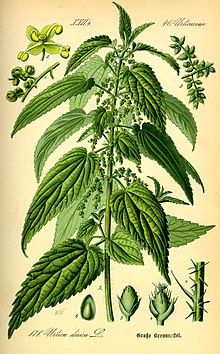
| stinging nettle (urtica dioica) |
I am currently a member of the Greater Lakes American Herbalist Guild Chapter here in Chicago, and we took a poll to see which herbs people in our group utilize. Nettle made it's way to the top of the list. I've never personally used nettle, but after reading about it, I can see why it's a favorite of herbalists in my area. I will certainly begin including it in my tonics and teas in the future.
History
Although nettle is seen as an invasive weed, it is an incredibly adaptive and pervasive plant that can be found in different varieties all over the world. In North America, the most common form used by herbalists is stinging nettle (urtica dioica).
According to A Modern Herbal, the history of the name "nettle" comes from its former use.
| The common name of the Nettle, or rather its Anglo-Saxon and also Dutch equivalent, Netel, is said to have been derived from Noedl (a needle), possibly from the sharp sting, or, as Dr. Prior suggests, in reference to the fact that it was this plant that supplied the thread used in former times by the Germanic and Scandinavian nations before the general introduction of flax, Net being the passive participle of ne, a verb common to most of the Indo-European languages in the sense of 'spin' and 'sew' (Latin nere, German na-hen, Sanskrit nah, bind). Nettle would seem, he considers, to have meant primarily that with which one sews. |
Stinging nettles are known for their needles which inject chemicals into your skin if you happen to brush them. These chemicals sting (hence the name) and cause raised bumps on your skin. The sting disappears when nettle is cooked or dried, however. Not all nettle stings, but stinging nettle is most popularly used in Western medicine.
NOTE: You can forage for your own nettle in many areas in North America, but make sure to wear gloves, be able to identify the plant correctly, and always cook the nettle or make it into tea before ingesting. Some herbalists say that you can roll the nettle in your GLOVED hands to break the needles off and chew on it raw, but this is something I recommend only for those who have worked with nettle and who are very brave.

Uses
Internally, nettle leaves are used for MANY different ailments. They include too many to mention, but there is an extensive list of nettle's uses by Kassie Vance on her website.
The reason this herb is used for so many ailments is its rich mineral content. According to Steve Brill, nettles are rich in calcium, magnesium, iron, potassium, phosphorous, manganese, silica, iodine, silicon, sodium, and sulfur. They also provide chlorophyll and tannin, are a good source of vitamin C, beta-carotene, B complex vitamins and protein. This combination makes nettle a super-food of sorts!
Stinging nettle is a strengthening tonic that can lift your spirits and calm irritability. According to Gayla Trail, nettle tea can help allergy sufferers fight symptoms of seasonal allergies. Know that it has to build in your system — you can’t expect to drink one cup of tea and find yourself symptom free. The tea itself tastes green and rich, unlike many other teas, and is pleasant to drink on a regular basis. Nettle is actually a drying agent and helps to dry up excess mucus as well.
 |
| picking nettle in the wild for tea- notice the gloves! |
Disclaimer: Nettle may lower blood pressure and heart rate. Avoid chronic use due to its diuretic effects. Do not take if pregnant or breast-feeding. Do not take if diabetic. Also, lots of nettle tea will make you have to pee a lot.
Recipes
Greg Seaman offers a simple way to make tea from nettles that you have collected yourself. Fresh nettles are best when foraged for in the wild.
Add water to your collected nettle leaves and heat to a near boil. Use about two cups of water for a cup of leaves. You can make the tea stronger by steeping longer, or weaker by adding more water. Once the water is near boiling, reduce heat and simmer for a couple minutes. Pour through a small strainer and enjoy.
NOTE: When using any new herb, it's best to start with one cup a day, and then gradually increase your dose to more once your body recognizes it as the wonder that it is.
If you'd like to try something really different, make Nettle Soup. Nettle soup is delicious and nutritious.
I am looking forward to speaking with my fellow herbalists about nettle and learning more about this powerful herb in our next meeting. To my followers, I hope you enjoy this information and do more research as there is so much more to this herb!
References
herbwisdom.com
yougrowgirl.com
A Modern Herbal: Nettle
Wild Man Steve Brill: Nettle

